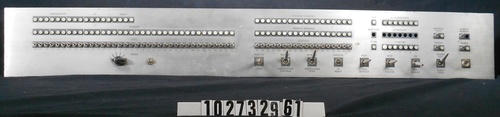
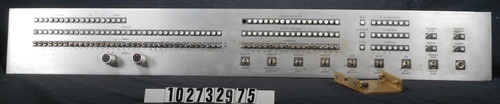
- built with Germanium transistors, rebuilt with Silicon transistors. [RCC1990]
- [DECUSCOPE 1964]
Vol III, No. 12, December 1964, p. 4 (pdf pg 40):
"System 1 is the prototype located at Maynard, Massachusetts. It is being used to develop more advanced time-sharing systems, and has been operational since Spring of 1964. Further use of the PDP-6 in Maynard is discussed by Mr. Harrison ["Dit"] Morse in his article on Page 1.
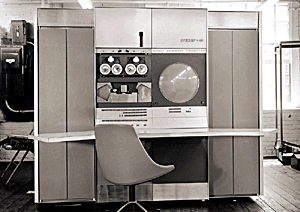
from Gordon Bell (click to enlarge)- Gordon Bell and Alan Kotok

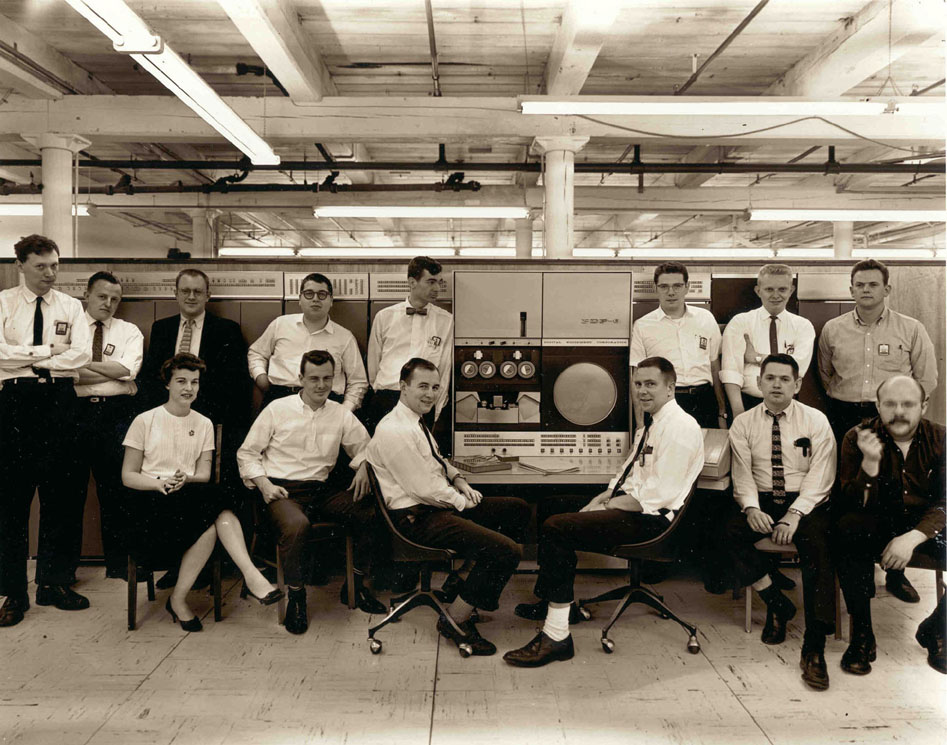
from Gordon Bell - PDP-6 Team
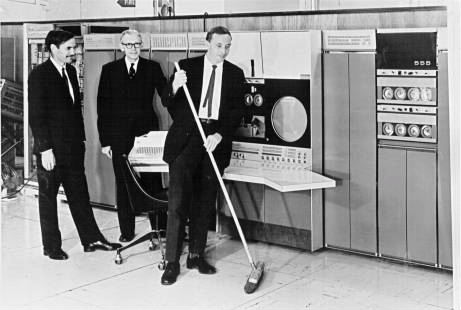
from Gordon Bell (click to enlarge) - Dennis Moore (UWA) sweeping up while visiting Digital
(per Angelo Papenhoff): - Alex Reid PDP-6 Facts
- Gordon Bell
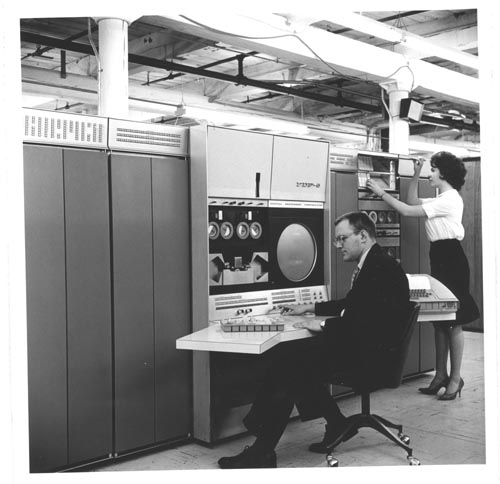
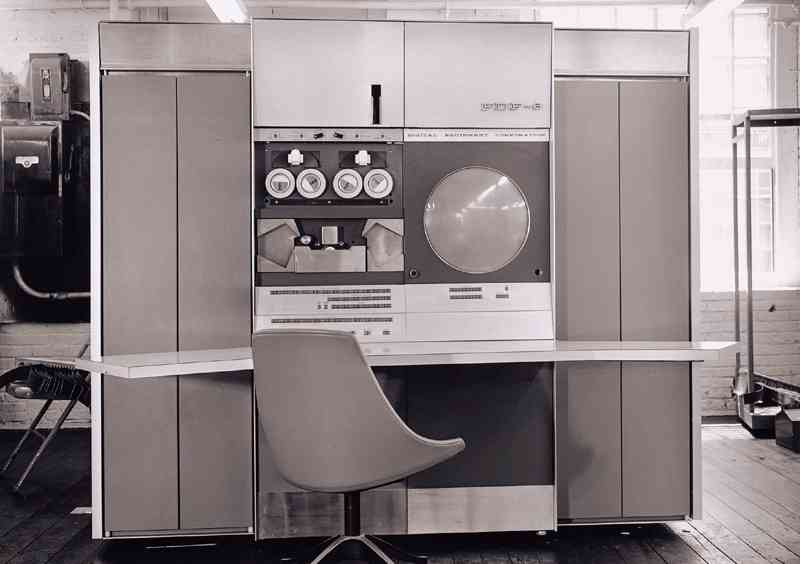
- Invoice dates 12/24/64, 3/26/65 [JPH1965]
- [HA1965-2] says delivered in April 1965 document
- [HA1965-3] says delivered in October 1965 document
- [HA1965-4] says running in 8/6/65 memo.
- Photo timeline (includes plaque: "Delivered 6 October 1964, Demolished 16 February 1982)
- [DECUSCOPE 1964]
Vol III, No. 12, December 1964, p. 4 (pdf pg 40):
System No. 2 has been installed at M.I.T.'s Project MAC since November 1964. They are planning to use the PDP-6 as an integral time-sharing component interfaced to the 7094 for the purpose of studying visual communication methods between man and machine. Dr. Minsky of the institute plans to use it also for development of programming languages and information retrieval.
- [MAC1966] p. 13 mentions video/arm hardware.
- A. COMPUTER AND RELATED HARDWARE
- The system is based on a DEC PDP-6 computer and related devices. With this is associated an assortment of tapes, printers, memories, input- output channels, and CRT displays. Unique to the manipulator project are a number of special interface connections for the devices described next. Because of the unusual size and complexity of the programming systems involved, a very large and fast core memory (218 words of 40 bits; 2.5- microsecond cycle-time) is to be added during the summer of 1966.
- B. SPECIAL INPUT DEVICES
- The sensory equipment includes two visual-input devices: TVA, a vidicon television camera, and the more precise TVB, an image-dissector device for controlled-scan analysis. Currently in use is a continuous- position-and-pressure-detecting tactile sensor, based on a time-domain reflectometer. For position sensing, there are a variety of inputs from the hand and arm. A more versatile system has been designed and is under construction.
- C. SPECIAL OUTPUT DEVICES
-
The manipulator, shown in Figure 1, consists of a
hydraulically-powered, electrically-controlled industrial arm, and a
hand with five degrees of freedom (but with only a simple gripping
ability). The arm was built and given to us by the American Machine
and Foundry Company, and is sufficient for our pres- ent simple goals.
More versatile hands and arms are being developed to be available when
programming is able to cope with more intricate manipulation.
A new arm, almost completed, is shown in Figure 2. This arm, specifically designed for the project, will be less massive and more versatile than previous designs. Its two main parts are a shoulder and an arm. The shoulder is a strong but slim stand, that terminates in a two-axis rotation joint (not shown in these pictures). The arm is a modular jointed system. Each section consists of a long tetrahedral "bone" with two hydraulic-cylinder "biceps". With four sections, the system resembles a tentacle (or really a lobster arm) rather than a humanoid or industrial-type arm. Since it is important that the "hand" bo able to reach any point in a portion of space from any direction, this requires at least six axes, in addition to grasping.
- Tom Knight's "PDP-6 Home Page": (scans of print set and harware maintenance manuals!!)
- https://archive.org/stream/bitsavers_charlesRivit14971part2Jul80_43225678/US_vs_IBM_Exhibit_14971_part_2_Jul80_djvu.txt:
In early 1964, Project MAC at MIT sought proposals for
the development of "an extremely advanced timesharing system"
...
Digital Equipment Corporation
bid "a multiprocessor version of its PDP 6 computer" and was "in
among the finishers". The winner was General Electric and,
in addition, "a $1 million PDP-6 was purchased by MAC as a peripheral processor".
- [DEE1972] section 3(b) "The Dual Processors"
The Artificial Intelligence Laboratory ITS system includes both a PDP-10 computer and a PDP-6, its slower predecesor. These are configured to give the PDP-6 a small private core memory which is accessible by the PDP-10, where the time-sharing monitor runs. Normally the PDP-6 can not access the memory being primarily used by the PDP-10. Each processor has exclusive control over some basic input-output devices attached to their input-output signal buss but beyond these devices the busses are time multiplexed into a single buss with an extra signal which indicates which processor has the shared buss for any particular cycle. Devices on the shared buss normally have simple assignment hardware which allows one processor at a time to seize each of them. Until released by their controlling processor they ignore commands from the other processor except that an attempt to read their status will reveal their processor assignment state.
All of the important robotics devices on the Artificial Intelligence Laboratory system are on the shared input-Output buss and may be assigned to the PDP-6 where programs of unusual time criticality or input-output organization can be developed. Through ITS, the PDP-6 can be made to appear as a procedure in a s procedure tree. Thus programs can be easily loaded into or dumped from the PDP-6 and to some extent controlled and debugged by a procedure running on the PDP-10. To further facilitate interprocessor communication, a device has been made accessible to each computer by which it can interrupt the other. If the PDP-10 is thus interrupted by the PDP-6, ITS will communicate this to the procedure in the time-sharing system that has attached the PDP-6. Finally, a system call is available in ITS to similarly interrupt the PDP-6.
- http://hack.org/mc/retro-computing/texts/its-calls-124.txt OPEN call:
A jname of PDP6 or PDP10 opens up the PDP-6 as the "job". (PDP10 as a jname goes back to the days when the PDP-6 ran ITS and the PDP-10 was the auxiliary processor!)
- [DEE1972] section 5(a) "The ARPA Network"
A skeletal pseudo-ITS was written to run on the PDP-6. It has all the necessary hooks to attach the network Code and an even greater propensity than regular ITS to halt at the first sign of trouble. As a result of this means of development, the ARPA network will be usable, in a limited manner, from the Artificial Intelligence Laboratory even when ITS or the PDP-10 are unavailable.
- https://groups.csail.mit.edu/mac/ftpdir/scheme-mail/HTML/rrrs-1986/msg00261.html: "What should the dedication be? Sussman suggested the PDP-6, which was the world's first Lisp machine, but some people didn't like this joke."
- Gerald J Sussman at PDP-6 and 340 Display:
(space war controllers at rear?)
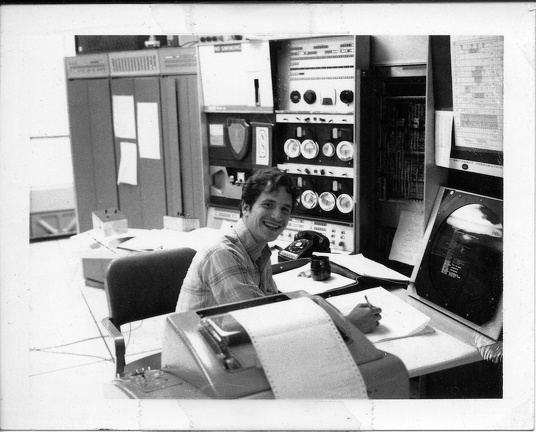
- David Waltz at PDP-6:
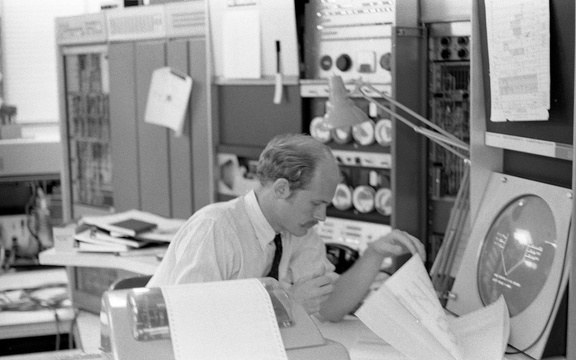
- Bill Henneman at PDP-6:
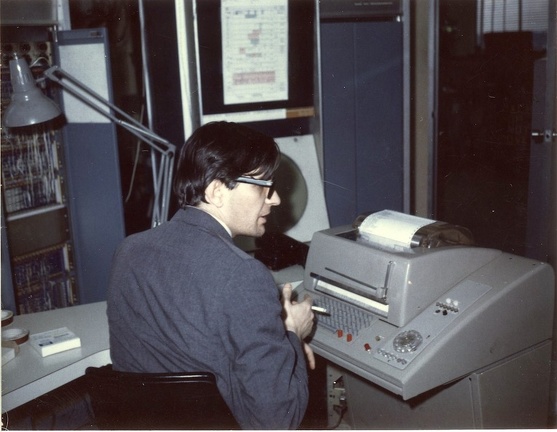
- Richard Schroeppel, Michael Speciner
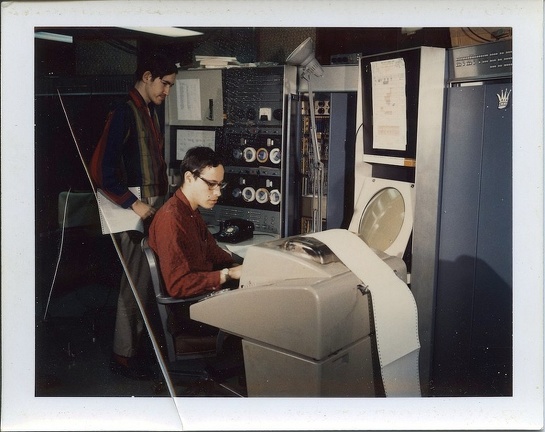
- [DEC1967] 1967 configuration: 64KW!, 340, PTR/PTP, 2xDECtape
- photo of console (owned by Tom Knight)
- photo of Fabritek "moby" memory
- Original Invoice dates 1/21/65, 2/8/65 (cancelled?); Invoice date 10/29/65 [JPH1965]
- [HA1965-2] says delivered in April 1965 document
- [HA1965-3] says delivered in an October 1965 document
- [HA1965-4] says running in 8/6/65 memo.
- Second sold? Lived in a trailer. [PH1984]
- https://cds.cern.ch/record/862581/files/921.pdf:
The PDP-6 computer, .... was, after delivery in January, 1965, debugged to the point where later in 1965 time-sharing was adoped as the operational mode, and multi-user operations have expanded ever since.
... Figure 1 shows a typical configuration of users utilizing the PDP-6 system during the previous year or so (prior to the summer of 1969 AGS shutdown). By this time the PDP-6 had been expanded to include 80-96K of 2.0 microsecond core, a 450,000 word disc, five high performance magnetic tapes, 8-10 DECtapes and two printers. It also included a remote I/O user station which contained a printer and DECtapes.
- Bob Clements was the on-site field-service engineer [alt.sys.pdp10 11/13/2008] [RCC1990]
- [DECUSCOPE 1964]
Vol III, No. 12, December 1964, p. 4 (pdf pg 40):
System No. 3 is scheduled to be installed at Brookhaven National Laboratory this month. To be used in high energy physics work, this unique system is mounted in a large trailer and is completely mobile. The PDP-6 replaces the Merlin System for the purpose of on- line reduction of data derived from scintillation counter hodoscopes, sonic spark chambers and wire spark chambers.
- [DEC1967] 1967 configuration: 32KW, 8xDECtape, PTR/PTP, LPT, 3xMT, 630
- Invoice date 5/18/65 [JPH1965]
- [HA1965-2] says delivered in April 1965 document
- [HA1965-4] says running in 8/6/65 memo.
- [HA1965-3] says delivered in an October 1965 document
- First sold [PH1984]
- http://research.microsoft.com/en-us/um/people/gbell/Digital/timeline/36-bit.htm: November 1965: In what is believed to be the earliest example of around-the-world networking, a link is made by operating a PDP-6 in Perth, Australia from Boston via a telex link.
- http://research.microsoft.com/en-us/um/people/gbell/Digital/timeline/1965-3.htm: The PDP-6 was operated and programmed from Boston using a 12,000 mile, 5 hole telex code. It proved very difficult to generate a control C in 5 hole code. At one point in the session, Robin Frith in Perth asks Alan Kotok in Massachusetts, "Do you think you could let us poor Aussies have a bit of core?"
- Robin Frith was the DEC man on site [RCC1990]
- UWA APRN==3 in common.mac in 4.x sources at http://pdp-6.trailing-edge.com/4.x.tar.gz (?!) could have been zero-based!
- http://web.archive.org/web/20030717231423/http://ftp.qut.edu.au/pub/info/greet.txt:
Greetings to all you other DEC-10 aficionados! I started my association with DEC-10s in March 1969, with the PDP-6 installed at the University of WA, and finished it on 30-Jun-89 when the KL10 was decommissioned. The DEC-10 represents the pinnacle of programmers' computers! Sigh.
Signed: Alex Reid, Head, Office of Information Technology, UWA.
- http://web.archive.org/web/20001002001934/http://www.terrigal.net.au/~acms/z0104.htm:
The PDP-6 was the first computer sold by DEC in Australia and the first general purpose timesharing computer to be installed in Australia.
During 1963, five Australian universities were funded to buy large computers. A team from DEC visited Australia and as a result of seeing this demand, the PDP-6 development direction was changed from physics research to timesharing.
Only one, the University of Western Australia, made the extremely bold decision (for those days) to buy a timesharing computer from a small, unknown company in Massachusetts. The others bought batch machines from IBM and CDC.
This PDP-6, serial number 4, was shipped to Perth in December 1964.
The initial configuration consisted of a processor, 32,000 words (160Kbytes) of 36 bit memory with 5 microsecond cycle time, 8 DECtape drives, a 300 cpm reader, a 300 lpm printer, a special graphics screen and 8 teletype lines.
A total of 23 PDP-6's were sold world-wide. The Perth one was upgraded over the years and turned Perth into a "DEC" town for two decades.
- All parts now at Living Computer Museum, Seattle?
- http://www.iucr.org/iucr-top/people/maslen.htm: Acta Cryst. (1997). A53, 535-536.: .. a Digital Corporation PDP-6 (serial number 0004), which was used to control one of the first four-circle diffractometers in Australia, a Hilger & Watts Y-231, in 1967
- Photos of console in the Wireless Hill Museum:
from Peter Dreisiger:
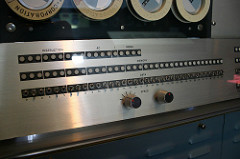
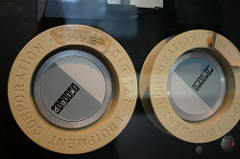

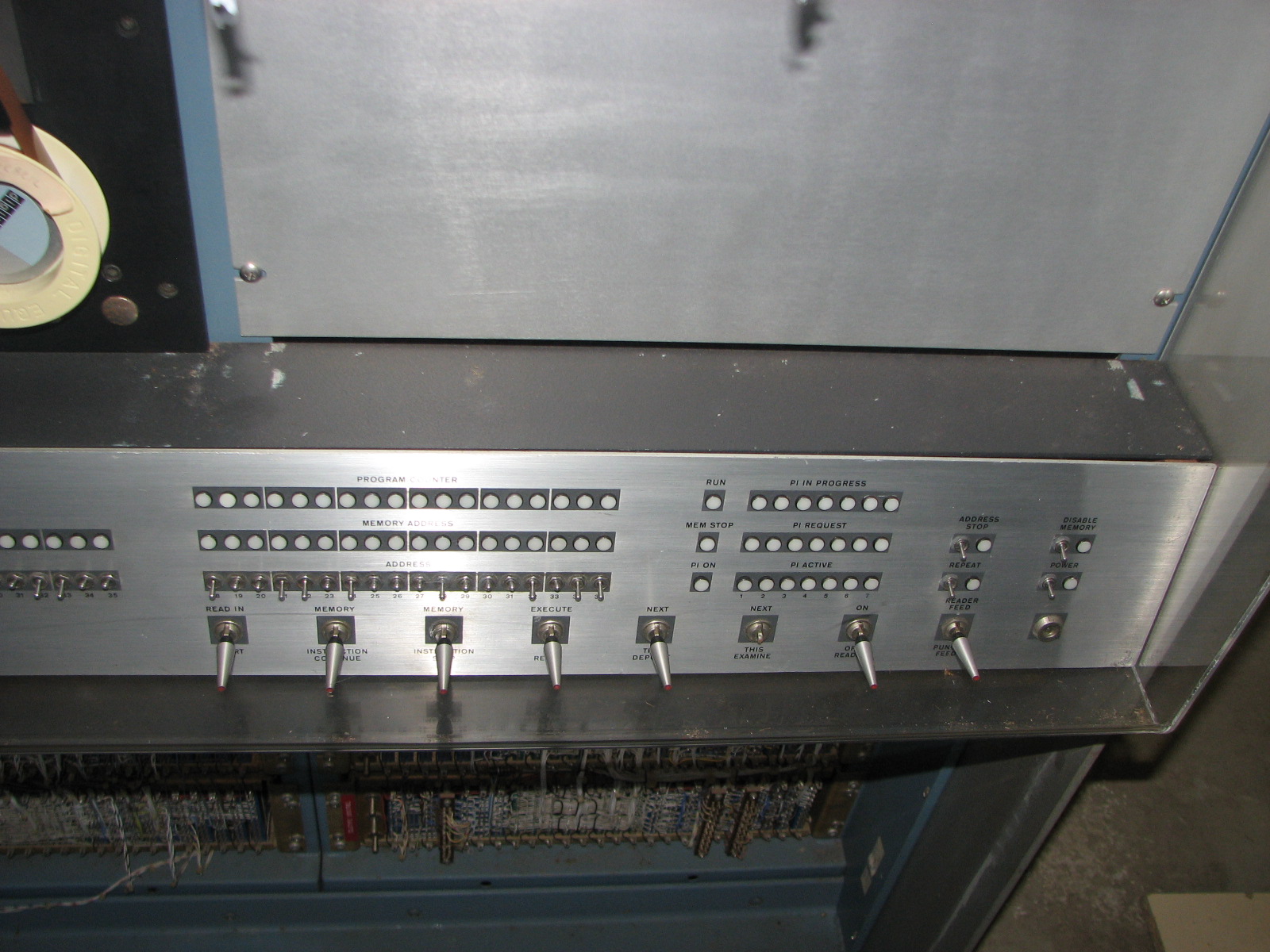
- http://www.library.uwa.edu.au/__data/assets/pdf_file/0006/2357574/DEC-PDP6-Facts.pdf: flyer with photo of console in Wireless Hill Museum
- [DEC1967] 1967 configuration: 16K core, 630, LPT, CDR, 346 display
- http://www.aceware.iinet.net.au/acms/HistoryOfAcmsWA.htm:
"Display unit sitting in my barn! I rescued it out of the rain from a scrap metal yard."

- http://www.alex-reid.com/Personal/Welcome-7.html:
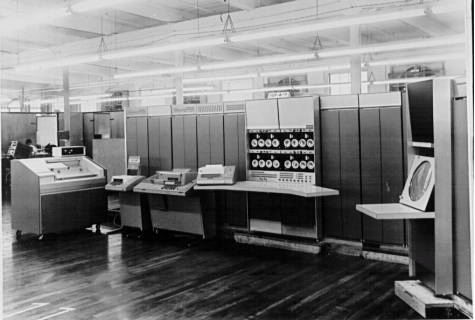
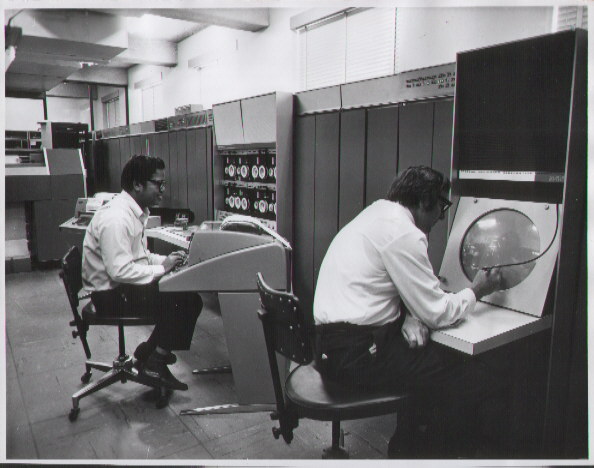
My first Time-Shared computer - the Digital Equipment Corp PDP-6. This was delivered to the University of WA in May 1965, and became the first commercially-delivered time-shared computer anywhere in the world.
Pictured before it left the factory in Maynard, Massachussetts:
Pictured towards the end of its useful life (1972), with Dennis Moore and Yow Kwan:
- http://www.decodesystems.com/pdp6.html: The first PDP-6 time-sharing system produced for sale is scheduled for installation at the University of Western Australia in January, 1965
- http://www.aceware.com.au/acms/ItemDetail.asp?lngItemId=175: photos of 340 display cabinet
- http://www.aceware.com.au/acms/ItemDetail.asp?lngItemId=176: photos of System Modules in 340 display
- http://www.aceware.com.au/acms/ItemDetail.asp?lngItemId=177: photos of analog to digital converter in 340 display
- [DECUSCOPE 1964]
Vol III, No. 12, December 1964, p. 4 (pdf pg 40):
The University of Western Australia, Nedlands, Western Australia will be receiving System No. 4 early in 1965. This will be the first computation center installation where the central processor will be time shared via remote teletype stations. The scientific computation center will be used in crystalography research and time sharing will aid student training in computer technology. The PDP-6 will also be used for accounting and information retrieval by the Administration Department.
- PDP6 computer at University of Western Australia. Syd Hall programming real-time interface to a Hilger-Watt diffractometer, 1967
from iucr.org:
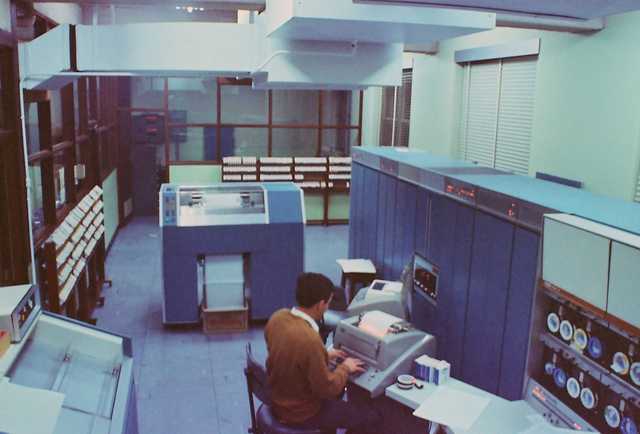
- [CHMDEC] p633: PDP-6-4, Western Australia
- Invoice date 2/11/65 x2 [JPH1965]
- [HA1965-2] says delivered in April 1965 document
- [HA1965-4] says running in 8/6/65 memo.
- [HA1965-3] says delivered to LRL on an October 1965 document
- http://www.computer-history.info/Page4.dir/pages/Storage.dir/: The Octopus network interconnected the Laboratory's supercomputers and various peripheral services. The original Octopus architecture included a pair of DEC PDP-6 computers, later upgraded to PDP-10s, as the network's central node (the "head" of the octopus).
- http://www.computer-history.info/Page4.dir/pages/Octopus.dir/OctopusArticle/Octopus.html:
The current Octopus network was evolved from the original Octopus concept pictured in Figure 1.
The original network consisted of a central system (PDP-6 and core memory buffer) with tentacles extending to worker (host) computer systems and various storage and I/O equipment. It was envisaged that this central system would manage the shared data base (Data Cell and Photostore), be a message concentrator for interactive terminals (TTY's), and manage pools of local and remote I/O equipment. It was even considered possible for the central system to perform some load leveling. Most of the intended host computers at that time had differing batch operating systems so load leveling would have involved some difficult conversion problems.

- https://codesign.llnl.gov/codesign-historical-references.php: Digital Equipment Corporation PDP-6 systems that were used to run the LLNL storage archive had LLNL-developed hardware modifications that DEC formally adopted in the PDP-10 system released in 1966.
- http://www.internet-history.info/media-library/mediaitem/1170-llnl-octopus-network.html: at 6:49 Mentions Octopus, and says they wrote their Operating Systems in LRLTRAN, a FORTRAN dialect.
- http://web.archive.org/web/20040619222353/http://www.nersc.gov/~deboni/Computer.history/pdp6.console.jpg:

- http://web.archive.org/web/20040619224937/http://www.nersc.gov/~deboni/Computer.history/2.pdp.6.consoles.jpg:

- http://web.archive.org/web/20040621041934/http://www.nersc.gov/~deboni/Computer.history/Lafranchi.html:
EL: ... Pehrson arrives in '65 and was very instrumental in a PDP-6. I think it was being prepared as the main OCTOPUS controller. Putting in a memory pagination and segmentation system.
GAM: You guys were designing the Pag-Seg (Pagination & Segmentation) unit and that was supposed to be added to the PDP-6. Wyman said no one ever used it.
replaced by KA10's - http://web.archive.org/web/20030402030119/http://www.ornl.gov/ORNL/SC/norman_hardy_1.html:
NH: They and Mel Pirtle were designing the SDS 940, yes. It was what they called the 930 from XDS, which was the same company that built the Sigma 7. The 930 was a machine much inferior to the PDP-10, but it was cheaper. And Berkeley got one, and sort of did magic on it--they did their own paging stuff. And that machine became the prototype for the 940. - http://research.microsoft.com/users/GBell/Computer_Engineering/00000532.htm Although we predicated the original PDP-6 hardware on multiprocessing, the Monitor was not designed explicitly for it. Lawrence Livermore Laboratory did build a two-processor system with their own operating system and special segmentation hardware
- "There was one at LLL (Now LLNL) This is where I saw a running Stretch while on a service call for the PDP6." [RCC1990]
- [DECUSCOPE 1964]:
Vol III, No. 12, December 1964 (pdf pg 48):
Lawrence Radiation Laboratory is scheduled for System No. 5. The laboratory plans to use the PDP-6 as the I/O processor in the OCTOPUS System. Its function will be to control all input/output transfers between each of the following components:
2 IBM 7094's
2 CDC 3600's
3 IBM 1402's
1 CDC 6600
1 IBM STRETCH
1 UNIVAC LARC
10 Tape Units
30 Displays
1 Radiation printer (30,000 Ipm) - PDP-6 to CDC 7600 Adapter at CHM
- [DEC1967] 1967 configuration (Lawrence Radiation Lab): 32K, PTR, MT, IBM interface
- [HA1965-2] says delivered in April 1965 document
- "There was one at a timesharing bureau in Cambridge called Keydata; that outfit failed, perhaps in part due to that particular PDP6 being quite flakey (a big machine)." [RCC1990]
- https://en.wikipedia.org/wiki/Keydata_Corporation
- [DECUSCOPE 1964]
Vol III, No. 12, December 1964, p. 4 (pdf pg 40):
The largest PDP-6 configuration being built to date is System No. 6, Keydata Coporation, a subsidiary of Charles W. Adams Associates, will install the system [in] Technology Square, Cambridge, Massachusetts. The Keydata facility, connected to terminals located on subscribers' premises, will function on-line in real-time to provide computer services to scientific and business users.
- [DECUSCOPE 1965] Volume 4, Number 4, April 1965
(DECUS Spring Symposium Agenda):
A REPORT ON THE IMPLEMENTATION OF THE KEYDATA SYSTEM
Charles W. Adams, C.W. Adams Associates, Inc.Abstract: The KEYDATA System utilizes a PDP-6 (with 48K core, a million-word drum, a 33-million-character disc file and a full-duplex Type 630 interface) as the control facility for on-line, real-time data processing services offered to business and engineering users through KEYDATA Stations (Teletypewriters) located on their preimses. Both packaged services, such as the preparation of invoices and the entry and correction of FORTRAN programs and data, operate through the KOP-3 executive routine.
... In the KOP-3 system, the drum serves as the primary storage for all data and programs 9except KOP-3) and also acts as the file directory, output buffer, and repository for the most active file records. Working storage is provided through automatic allocation of core memory in 32-word pages.
- Private e-mail from Bob Clements:
The untold story about Keydata is that it was indeed very flakey, mainly due to the huge number of small memory racks. They didn't go to an alternate memory vendor like MAC did. BUT when they gave the machine back to DEC, DEC did a thorough shakedown and sold it to United Aircraft. Where it ran very solidly for some years with almost no downtime.
- [CHMDEC] p11 (Harlan Anderson papers)
There is also a small amount of material related to the development and lease of the PDP-6 line, including operation plans, market analyses, product strategies, budgets, sales information, and the details of a failed agreement with Charles W. Adams Associates to lease a PDP-6 for Adams' Keydata Corporation division, which was ultimately terminated due to DEC’s failure to fulfill its obligations.
- [HA1965-1] gives #15 as a "Firm Order", delivery November 15, 1965
- Hartford, CT [RCC1990]
- Proceedings of the Spring Joint Computer Conference of 1966 pp356-363
- RSRA Sixth Scale Wind Tunnel Test Final Report Sikorsky Aircraft SER-72011, NASA CR-144968 for Sikorsky model S-72 (RSRA), pp 1-2,6 published Dec 04, 1974. NTRS Document 19760013038
- [DEC1967] 1967 configuration: 16KW, 6xDECtape, PTR, 630
- Invoice date 3/26/65 [JPH1965]
- [HA1965-2] says delivered in April 1965 document
- [HA1965-4] says running in 8/6/65 memo.
- [HA1965-3] says delivered in an October 1965 document
- https://www.physics.rutgers.edu/dept/history/robbins/chapt10.pdf:
Plano's PDP-1 computer was replaced by a PDP-6 computer in 1965, giving the Physics Department an advanced time-sharing machine with more power than the University's computing center. This was used for online checking and analyzing of the bubble-chamber experiments, and provided computing for the rest of the Department.
- http://www.inwap.com/pdp10/usenet/pdp6
- "lucky #7 never really worked correctly" [PH1984] (maybe this was Keydata's #6??)
- [DECUSCOPE 1964]:
Vol III, No. 12, December 1964 (pdf pg 48):
Rutgers University, Physics Department, will be using System No. 7 in their high energy physics work. Utilizing a film reader, they will perform nuclear particle analysis.
- https://www.physics.rutgers.edu/dept/history/robbins/chapt11.pdf:
After the submission of the 1965 proposal, some of the equipment listed in that proposal was obtained from the science section of the NSF, including $242,000 for the expansion of the PDP-6 computer.
- [DECUSCOPE 1966]:
A 16K PDP-6 system performing on-line checking and processing of bubble chamer data for four measuring machines has been in operation since June, 1965..... With an additional 16K of core memory and using the new FORTRAN IV compiler, on-line spatial reconstruction and kinematics will also be implemented. All of the above are in conjunction with the simultaneous use of the standard PDP-6 time-sharing software.
- [DEC1967] 1967 configuration: 8KW, PTR/PTP, 4xDECtape, 346 display
- In Proceedings of the Second Colloquium on PEPR, May 1970:
- Had computer since 1965
- 64KW, 4xMT, 6xDECtapes, 8xTTY, getting disk, No fast ACs!
- Invoice date 7/2/65 [JPH1965]
- [HA1965-4] says running in 8/6/65 memo.
- [HA1965-3] says delivered in an October 1965 document
- "There was one at RAND. It replaced the Johnniac, and only ran JOSS, an interactive language like a grown-up Basic, running on a custom golf-ball typewriter console. It was in RAND's machine room that I saw an IBM 360/44, inspiring me to design "Read-in Mode" on the PDP-10." ` [RCC1990]
- [DECUSCOPE 1965] Volume 4, Number 7-8, July-August 1965, under NEW DECUS MEMBERS list PDP-6 Delegate G.E. Bryan, The RAND Corporation, Santa Monica, California
- The JOSS Years: Reflections on an Experiment (PDF)
- JOSS: INTRODUCTION TO THE SYSTEM IMPLEMENTATION
JOSS is a time-shared computer system that provides for the solution of numerical problems via an easily learned language at remote typewriter consoles. The PDP-6 hardware used to implement JOSS consists of 32,000 words of 1.75m sec core memory, a 1-million-word 4m sec drum, a 6-million-word discfile, and various peripheral devices. A special data relocation mode for memory references has been added to facilitate interpretation of JOSS programs. The JOSS consoles, built around a Selectric I/0 typewriter, were specially manufactured to RAND specifications. Features include full duplex signaling, line parity checking, a page eject mechanism, and several buttons and lights to control and report console status. The stand-alone JOSS software consists of the JOSS language interpreter and its arithmetic subroutines, a monitor for user scheduling and resource allocation, and I/0 routines for the disc, drum, consoles, and other peripheral devices. JOSS service is currently available to nearly 500 users through 34 consoles, six of which are remote to RAND operating over both private and dataphone lines.
- [DEC1967] 1967 configuration: 32KW, MT, 630, PTR/PTP, 4xDECtape, 40 JOSS consoles, disc ctrl
- http://bitsavers.org/pdf/dec/pdp6/H-616_JOSSconsole_Mar66.pdf: DEC JOSS Console Manual
- https://github.com/PDP-6/JOSS-II/ PDP-6 JOSS document links, including supervisor listing, and retyped code
- https://www.rand.org/pubs/research_memoranda/RM5437.html Assembly Listing of the Supervisor by G. E. Bryan
- Invoice date 6/30/65 [JPH1965]
- [HA1965-4] says running in 8/6/65 memo.
- [HA1965-3] says delivered in an October 1965 document
- "There were a couple at various Max Planck Institutes in Germany." [RCC1990]
- [DECUSCOPE 1965] Volume 4, Number 6, June 1965, under NEW DECUS MEMBERS list PDP-6 Delegate Heinz Weber, Physikalisches Institut, Technische Hochschule, Aachen, Germany
- [DECUSCOPE 1965] Volume 4, Number 11-12, November-December 1965
UNIVERSITY OF AACHEN USING PDP-6 IN HIGH ENERGY PHYSICS RESEARCH
The PDP-6 consists of arithmetic processor and console teleprinter, 32,768 word memory, 200 card-per-minute reader, 300 line-per-minute printer, data control dual DECtape transports and control, two industry compatible magnetic tape transports and control, and a data communications system with six remote input/output stations.
- [DEC1967] 1967 configuration: 32K core, CDR, 2 MT, 630, LPT, PTR/PTP, 4 DECtape
- Invoice date 6/29/65 [JPH1965]
- [HA1965-4] says running in 8/6/65 memo.
- [HA1965-3] says delivered in an October 1965 document
- "There were a couple at various Max Planck Institutes in Germany." [RCC1990]
- [DECUSCOPE 1965] Volume 4, Number 1, January 1965:
University of Bonn, Bonn Germany has ordered a PDP-6 to be used in the control of a Precision Encoding and Pattern Recognition (PEPR) System.
This system will include the PDP-6, 2 core memories, 16,384 words ea., Data Channel Type 136, Mag Tape Control Type 506-521, DECtape Transport 555, DECtape control Unit 551, Type 340 Display w/ light pen, Mag Tape Transport, Card Reader and Control, Line Printer and Control, 630 Data Communications System for three stations utilizing console typewriter and two additional teleprinters Type KSR 33.
- [DECUSCOPE 1965] Volume 4, Number 5, (undated? May??)
NEWS ITEMS: UNIVERSITY OF BONN TO USE PDP-6 IN PHYSICS DEPT.
The PDP-6 is scheduled to arrive at the University sometime in June.
- [DEC1967] 1967 configuration: 32KW, 346 display, CDR, 2xMT, 630, LPT, PTR, 4xDECtape
- Invoice date 2/17/65 [JPH1965]
- [HA1965-1] gives #11 as a "Firm Order", delivery Sept 30, 1965
- Used with PEPR (Precision Encoding and Pattern Recognition) bubble chamber film scanner: Status of MIT's PEPR's Watts, T L, from CERN International Conference on Data-Handling Systems in High-Energy Physics, v 1, 23 - 25 Mar 1970, Cambridge, England (mentions 75%-82% uptime, more trouble from other H/W than PDP-6) Active in January 1970 (replaced by a KA10 in March 1970?). Processed 30-inch film from ANL (Argone National Labs Zero-Gradient Synchrotron??) and 82-inch film from SLAC
- http://www.inwap.com/pdp10/usenet/smp" John Everett wrote the original [DEC Timsharing monitor] master/slave multi-processor support was written by Mike Church at MIT/LNS. We (DEC) took Mike's code and integrated it into the monitor sometime around 1970 or so.
- [DECUSCOPE 1964]
Vol III, No. 12, December 1964 (pdf pg 48):
System No. 8 is scheduled for M.I. T.'s Laboratory for Nuclear Science. The laboratory will use the PDP-6 to control their Precision Encoding and Pattern Recognition (PEPR) System. The role of the PDP-6 in the system is to generate the scan pattern commands, store the coordinates of the detected tracks, and single out those tracks which are of interest to the investigators.
- [DEC1967] 1967 configuration: 16KW, PTR, MT, 4xDECtape, CDR, 348 display, 630
- Invoice date 10/20/65 [JPH1965]
- [HA1965-1] gives #11 as a "Firm Order", delivery August 31, 1965
- Used by Dr. Glaser, inventor of the bubble chamber
- located in basement of Cory Hall? -- http://www.inwap.com/pdp10/usenet/pdp6
- [DECUSCOPE 1966]:
BACTERIA-SCANNING SYSTEM CONTROLLED BY PDP-6
A computer-based scanning system to study bacteria, viruses, and other microorganisms which infect man is being built by the University of California at Berkeley under a grant from the Public Health Service.
The primary purpose of the research program, which will use the new system, is to make an intensive study of the hereditary characteristics of microbes. Investigators will try to learn what nutrients the microorganisms need, to what drugs they are sensitive, and what happens to them in various temperature, lighting, and environmental changes.
The scanner will also serve as an experimental diagnostic system to identify infectious diseases sooner than is now pos- sible. More rapid diagnosis, permitting faster selection and administering of the most effective drug, could result in more rapid recovery in addition to shedding light on the genetics and physiology of the microorganisms.
The system is being built as part of a 5-year, $1.24-million program to be administered by the National Institute of General Medical Sciences. Directing the program is Dr. Donald A. Glaser, professor of physics and molecular biology at the University and a Nobel prize winner in physics.
The new system, similar in concept to others being used in several leading physics laboratories to study the structure of the atom, will identify microbes by comparing them with stored images of all known types. Dr. Glaser believes identification may be possible within 12 to 18 hours after examining a patient, rather than after the 48-hour incubation period commonly needed now.
The system will be controlled by a PDP-6 computer. Stored in its memory will be characteristic patterns of known microbes. Examining the unknown microbes in a specimen taken from the patient will be an optical device known as a flying spot scanner.
The scanner uses a cathode ray tube as a light source and a light-sensitive device as a detector. The specimen is posi- tioned between them, and the light beam of the cathode ray tube sweeps repeatedly across the specimen under control of the computer. The varying amounts of light reaching the detector as the light beam passes from transparent to opaque areas of the specimen enable the computer to recreate in its memory the mathematical representation it needs to com- pare the unknown and known patterns.
- referenced in http://onlinelibrary.wiley.com/doi/10.1111/j.1749-6632.1966.tb41198.x/abstract
"AN AUTOMATED SYSTEM FOR THE GROWTH AND ANALYSIS OF LARGE NUMBERS OF BACTERIAL COLONIES USING AN ENVIRONMENTAL CHAMBER AND A COMPUTER-CONTROLLED FLYING-SPOT SCANNER*" Donald A Glaser and Willard H. Wattenburg;
Volume 139, Axenic Cultures and Defined Media, pp 243-257
* This investigation has been supported in part by the Atomic Energy Commission and is currently supported by the National Aeronautics and Space Administration under Grant NGR-05–003–091, by the Public Health Service through research grants GM 12524 and GM 13244 from the National Institute of General Medical Sciences, and the Joint Services Electronics Program under Grant AF-AFOSR–139–65.
- [DEC1967] 1967 configuration: 16K core, PTR, CDR, 4xDECTape, LPT, 346 display
- Installed by Bob Clements, custom CONS instruction [RCC1990]
- [HA1965-1] gives #16 as a "Firm Order", delivery November/December 1965
- http://forum.stanford.edu/wiki/index.php/Early_Computers_at_Stanford: The first computer installed at the Stanford Artificial Intelligence Lab was a DEC PDP-6, delivered in June of 1966
- http://www.stanford.edu/~learnest/sailaway.htm: "a 6-console display system that drew text and vectors with a random-access electron beam was added in 1967"
- http://www.stanford.edu/~learnest/sailaway.htm: "The original PDP-6 system had just 64k words of storage (which occupied eight large cabinets) and used microtapes for secondary storage. A fixed-head disc file built by Librascope, added in 1968, was supposed to function both as a swapping store and a permanent file store, but it turned out to be so temperature-sensitive that it was useless for file storage. The six remarkably large discs in this system, which were each 4 feet in diameter, were eventually sold as coffee tables -- I have one in my living room. Despite its large physical size, this disc system had a capacity of only about 100 megabytes. More reliable disks made by IBM, Ampex and DEC were added in later years."
- http://www-db.stanford.edu/pub/voy/museum/pictures/display/3-3.htm:

"DEC Team and Core Memory (the memory plane has been moved to the basement)" - Retired 1980: "Stanford's PDP-6 was shown at DECUS in 1984. The machine was transferred to a DEC warehouse after that event. There are no records of this machine being given to the Computer Museum, which was not part of DEC in 1984. In the late 1990s Compaq donated the contents of the DEC internal archives to The Computer Museum History Center. The Fast Memory cabinet from the Stanford PDP-6 was part of that donation. There is no evidence that the modules sold at the Boston computer museum gift shop were from the Stanford PDP-6, nor is there any evidence that the museum had ever had this machine in its possession." [wikipedia]
- On display at 1984 DECUS: http://www.opost.com/dlm/tenex/:
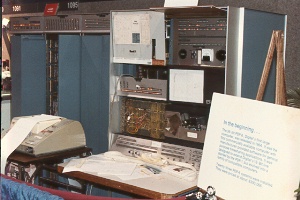
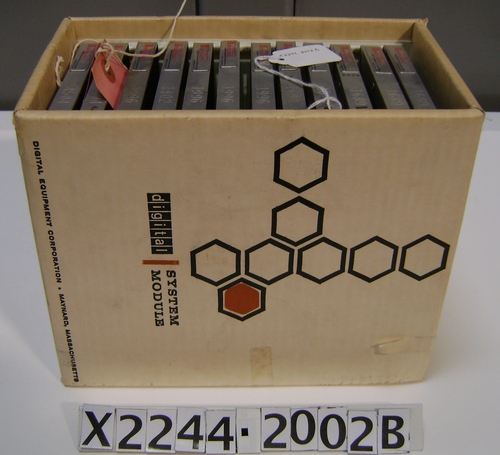
- TCM has box of spare parts:
http://www.computerhistory.org/collections/accession/X2244.2002B
There are 12 modules in original DEC cardboard box. The object is from Stanford's PDP-6 (from Bruce Kennard, Stanford DEC CE). The object category needs to verified by content specialist. Exhibit label for a PDP-6 Module (including contextual paragraph) is located in Object File. -- JAC 10/25/2001
- [DEC1967] 1967 configuration: 32KW, PTR/PTP, 8xDECtape, LPT, 630, 167 drum
- John Montgomery (former DEC Field Service) reports that the consensus of a couple of colleauges is that it was serial #17 [private email July 2019]
- [HA1965-1] gives #18 (or 19) as a "Firm Order", delivery December 31, 1965
- [DECUSCOPE 1965] Volume 4, Number 10, October 1965
PDP-6 AND PDP-8 JOIN EMPEROR VAN DE GRAAF ACCELERATOR
Rochester University's Nuclear Structure Research Laboratory will be installing an on-line time-sharing computer system for experimenting with its new Emperor Van de Graaf Accelerator some time in January. The system will be used for time-shared computation and on-line data acquisition for several nuclear experments. Major elements of the system are PDP-6 and PDP-8 computers and a new intercommunication subsystem.
- [DECUSCOPE 1965] Volume 4, Number 11-12, November-December 1965 New PDP-6 Delegate: Anthony Yonda, University of Rochester, Rochester, New York
- [DEC1967] 1967 configuration: 4xDECtape, 16KW, 165B/C?
- [DECUSCOPE 1965] Volume 4, Number 7-8, July-August 1965, under NEW DECUS MEMBERS list PDP-6 Delegate William B. Easton, Applied Logic Corporation, Princeton, New Jersey
- Aurbach Guide to Time Sharing
http://bitsavers.informatik.uni-stuttgart.de/pdf/auerbach/GuideToTimesharing_Jan73.pdf:
"Became operational in January 1966"
- [DEC1967] 1967 configuration: 32KW, PTR/PTP, 2xDECtape, LPT, 630
"... DEC started to ship all its products by truck. Twelve-foot trucks. DEC learned a lot more at a well-known bridge on Route 62 in Hudson, Massachusetts. An eleven-foot bridge. (This is where DEC made its first drop shipment.) The PDP-6 that made this unfortunate journey was already some months late for the University of Pennsylvania. DEC, not having its own van at the time, had rented some space in a moving van filled with household goods. The PDP-6 was in the back of the van, and it appears that the furniture successfully cushioned the impact of the computer. They did have to shovel the remains out of the truck afterwards, however. (The PDP-6 was able to be repaired in a couple of more months.)"[PH1984]
- http://www.upenn.edu/almanac/v30pdf/n30/041784.pdf "4/86 -- ties dating back 20 years"
- UPenn Almanac, Feb 1967,
The School of Medicine became owner of the fastest and most flexible computer on the Pennsylvania campus December 5 when the new Digital Equipment Corporation PDP-6 digital computer began operation. It replaces a computer system installed three and one-half years ago. The new computer, which cost $750,000, was purchased under a grant from the U. S. Public Health Service, which also has granted operational funds for the next six years. It has been installed in the Medical School's Alfred Newton Richards Medical Research Building.
- [DEC1967] 1967 configuration: 64KW!, PTR, 4xDECtape, LPT, 2xMT, CDR, 346 display
- https://www.ncbi.nlm.nih.gov/pmc/articles/PMC1351605/pdf/jphysiol01069-0267.pdf (4/69)
- https://books.google.com/books?id=jyrgBAAAQBAJ&pg=PA493&lpg=PA493&dq=University+of+Pennsylvania+Medical+School+pdp-6&source=bl&ots=w3ufaR6UB5&sig=yKQlZ87i0HHTYaw9xod9MIRrf4Q&hl=en&sa=X&ved=0ahUKEwiw0pyTxKbRAhUIOiYKHSr2DRgQ6AEIKDAC#v=onepage&q=University%20of%20Pennsylvania%20Medical%20School%20pdp-6&f=false
- https://www.ncbi.nlm.nih.gov/pmc/articles/PMC1166237/pdf/biochemj00586-0201.pdf (7/73)
- [DEC1967] 1967 configuration: 16KW, type 30 display, 4xDECtape, CDR (no CPU?)
- [HA1965-1] gives #19 (or 18) as a "Proposed Order", delivery by Jan 31, 1966
- [HA1965-1] gives #20 as a "Proposed Order", delivery Dec 15, 1965
- [DECUSCOPE 1966] Volume 5, Number 7 lists new PDP-6 Delegate R. Prescott, Imperial College, London, S.W. 7, England
- [DEC1967] 1967 configuration: CPU? 64KW!, 4xDECtape, 4xMT, PTP, CDR, LPT, type 30 display, data comm.
- [HA1965-1] gives #17 as a "Firm Order", delivery November 30, 1965 and #21 for delivery to New Mexico (Mines and) Tech by Feb 28, 1966.
- "The PDP-6 could support the Data Products
disk. That drive had about a dozen platters, each
of which was provided with an independently-movable,
hydraulically actuated arm.(*) When the heads got
moving, with the hydraulic hoses moving in and out
with the actuators, it looked like a spaghetti
factory. Dave Nixon of Oxford bought an IBM disk
drive for his system. Not knowing how to program it
as a disk drive, he made it emulate 40 DECtape
drives."
[PH1984]
(*)[PLB: I seem to recall Al Blackington saying he had done the disk driver for a disk like that. Could there have been two??]
- [DECUSCOPE 1966] Volume 5, Number 2 (February 1966) lists "PDP-6 DELEGATE" Frank Harris, Oxford University Nuclear Physics Laboratory
- [CHMDEC] p668: PDP-6-21 PEPR Oxford 1966-12-16
- [DEC1967] 1967 configuration: 64KW!, 4xMT, 6xDECtape, type 30 display, PTR/PTP, LPT
- [MAC1972] Page 60
Work on the Dynamic Modeling System began, effectively, in October, 1969, when a used PDP-6 computer with 32K words of memory was delivered to Project MAC.
- AI: CENT; TAPES SAVE
Full ITS first ran on the AI PDP6, and was ported to the DM PDP6. Later, PDP10s became available, and the labs acquired some of the earliest ones -- the AI-KA10 (AI Lab's machine), the ML KA-10 (used by the MathLab, Theory of Computation, Automatic Programming, and certain other LCS groups), and the DMS KA-10 (Dynamic Modeling Systems, also used by certain other LCS groups); these replaced the PDP-6s, which were slowly phased out.
- RFC89 (Jan 1971):
- Page 1: "The IINCP"
-
Our experiments were run on the MITDG PDP-6/10 using what we have
affectionately called our 'interim interim NCP' (IINCP). Under the
IINCP the IMP Interface is treated as a single-user I/O device which
deals in raw network messages. The software supporting necessary
system calls includes little more than the basic interrupt-handling
and buffering schemes to be used later by the NCP. In short, the
user-level programs which brought us to our historic moments were
written close to the hardware with full knowledge of IMP-HOST
Protocol (BBN 1822).
- Page 4: "The Harvard-MIT Graphics Experiment"
- At Harvard are a PDP-10 Time-sharing System and a graphics oriented PDP-1, both connected to Harvard's IMP. At MITDG are a PDP-6/10 Time-sharing System and an E&S Line Drawing System. It was felt (Messre. Barker, Cohen, McQuillan, Metcalfe, and Taft) that the time had come to demonstrate that the network could make remote resource available - to give Harvard access to the E&S at MITDG via the network.
- Project MAC Progress Report VII, July 1969 to July 1970 [MAC1970]
- Page 9:
-
The Dynamic Modeling Group, formed at the beginning of the
year to develop techniques and an interactive computer system
to facilitate the formulation and testing of ideas in terms
of computer-program models, acquired as a foundation for its
system a Digital Equipment Corporation PDP-6/10 computer
and the very sophisticated and responsive time-sharing software
developer since 1965 by members of the Artificial Inetlligence
Group.
.... In the areas of Computer Networks and Computer Graphics, the past year's efforts were mainly groundwork. The Interface Message Processor that will connect Multics and one or both of the PDP-6/10 computer systems to a coast-to-coast network of research computers was installed, and an advanced display subsystem was incorporated into the dynamic modeling computer system. At the end of the year, the net- work and graphics programs were shifting into high gear.
- Page 59:
- ... at Project MAC, both the Multics GE 645 system and the Dynamic Modeling and Computer Graphics Groups' PDP-6/10 system are network hosts.
- gunkies wiki
According to Tim Anderson, the Project MAC group Dynamic Modeling/Computer Graphics took delivery of the very last PDP-6 from a previous owner. They adopted the AI Lab's ITS operating system, but shortly after moved onto a PDP-10.
- Photo of Lick and Jeff Harris w/ DM PDP-6 shows 4 DECtape drives
- [HA1965-1] gives #14 as a "Firm Order", delivery by Oct 31, 1965 -- no other evidence of delivery. Colgate was a PDP-10 site.
- Mentioned in Twenty Years of 36-bit Computing with Digital